Six Crowns Chronicle IV -Living World- v1.3.1t8では、これまで段階的に開発してきた商会経営、株式市場、企業支配、人物の認知と家系記憶、国家臣従、軍団ユニットを、ひとつの公開ビルドへまとめました。さらに、主要画面の英語対応と、itch.io向けの保存・バックアップ機能を追加しています。
Page updated: · v1.3.1t8 / itch.1 · SCC4 Living World
These are cumulative update notes. Guilds, markets and Phase 7 systems span earlier builds; t8 adds group management, delegation, contract renegotiation and legion presentation. itch.1 adds expanded English UI and save transfer tools.
GUILD GROUPS & LEGION UNITS | English / Japanese Support
Swords are not the only force that can change the world.
Build a merchant guild. Accumulate shares. Place your trust in someone, face betrayal, and pass the memory down to your children.
Six Crowns Chronicle IV -Living World- v1.3.1t8 brings together the merchant guilds, stock market, corporate control, character cognition, dynastic memory, vassal realms, and legion units developed across our recent updates. This release also expands English support for the main interface and adds save-file backup and transfer tools for the itch.io edition.
Our goal is not simply to add more systems.
We want to build a world where economic events change relationships—and those relationships create history.
Merchant, investor, head of a dynasty, or commander of a legion: there are now more ways to take part in the Living World.
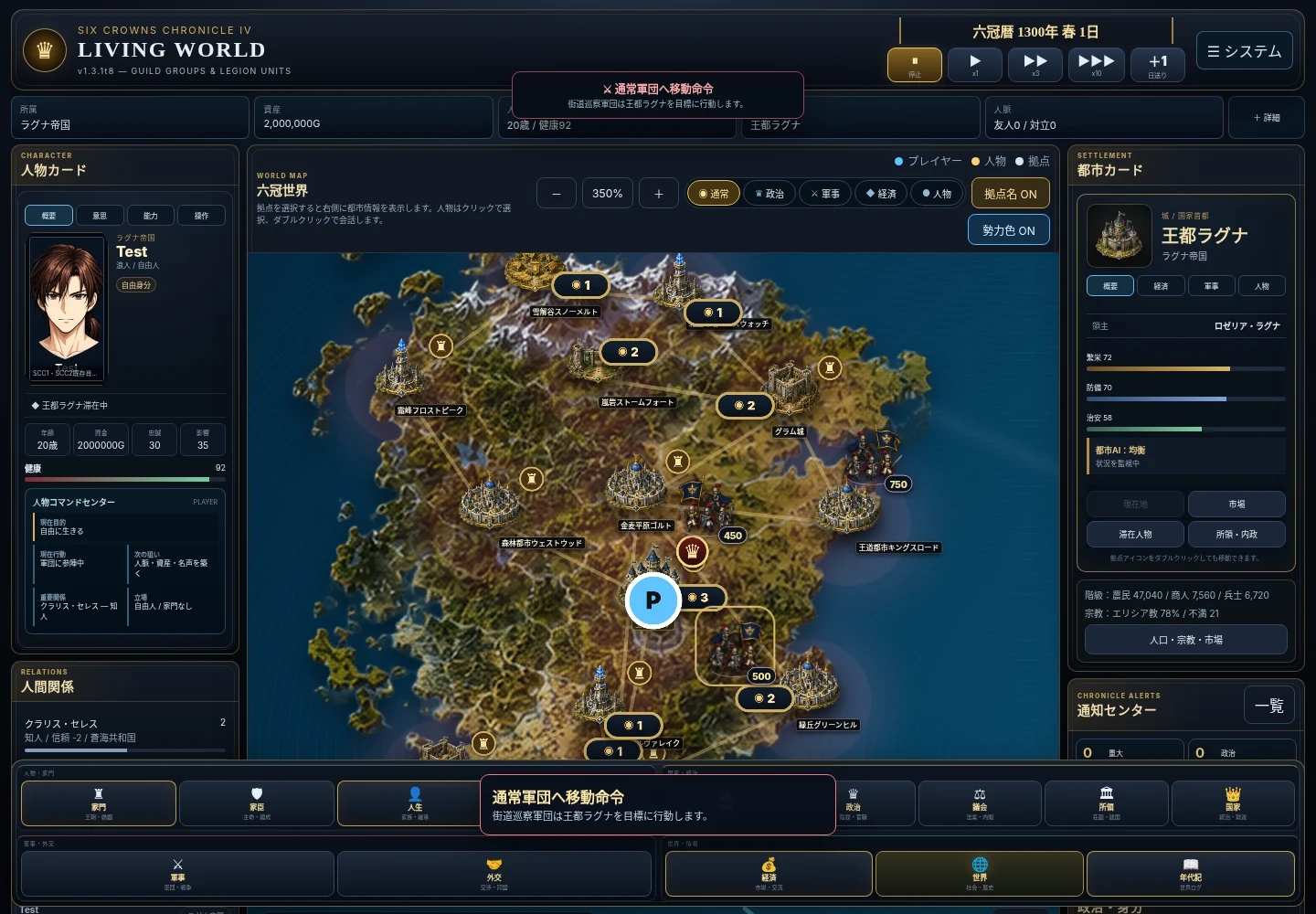
Legion units in v1.3.1t8 — test world.
Build Merchant Guilds and Grow a Business Empire
Merchant guild management has been substantially expanded. Both players and NPCs can establish guilds, and players can operate more than one company.
A single guild can also run multiple businesses. Choose from 14 industries—including trade, shipping, agriculture, food, mining, weapons, construction, and finance—and invest in divisions, change your primary business, or suspend and resume operations. These options are available to both listed and unlisted companies.
The Guild Group Management screen brings together the companies you manage directly, your controlling investments, and indirect subsidiaries. Review cash, profits, business divisions, contracts, and pending approvals before deciding where to invest next.
You can also appoint NPCs as business managers, set a management policy, and delegate a budget. Let a manager handle smaller investments while retaining approval over larger expenditures.
A capable person is not necessarily a trustworthy one. Abilities, personality, loyalty, and the relationship with the person who appointed them all influence management decisions.
Crown Exchange: A Stock Market with NPC Investors
The stock market is no longer a place where only the player trades. NPCs invest using their own funds, personalities, expectations of profit, and fear of losses.
Compare each company's market price and theoretical value, dividends, free float, liquidity, and ownership distribution. Market prices and theoretical values are tracked separately, allowing both overheated markets and periods of deep pessimism.
The trading interface includes bid and ask orders, market and limit orders, partial fills, your own order list, individual and bulk cancellation, cumulative quantities, and market-depth displays.
Placing an order is not the same as completing a trade. When there are not enough willing buyers or sellers, an order may fill only partially—or remain unfilled.
Prices respond to more than company earnings. City conditions, war, national stability, trade, order flow, rumors, and NPC sentiment can all influence the market.
Large visible orders can become information for other investors. One NPC may see a large sell order as a warning; another may see an opportunity to buy.
Beyond Trading: Corporate Control and Shareholder Meetings
Owning shares is only the beginning.
Through IPOs, new share issues, share buybacks, stock splits, tender offers, management integration, absorption mergers, and delisting, you can take part in the growth and restructuring of merchant guilds.
At shareholder meetings, vote on leadership changes and corporate restructuring, or seek proxies from other shareholders. When your own stake is not enough, persuasion becomes part of the struggle for control.
NPC shareholders consider more than the proposed financial terms. Trust, gratitude, resentment, national affiliation, and personal relationships also matter. An attractive offer can still meet opposition when the buyer is not trusted.
Friendly and hostile tender offers, takeover defenses, and full ownership through minority-share purchases by qualifying controlling shareholders are also available. Acquiring a large stake does not automatically trigger a merger: the relevant voting, funding, and execution conditions must still be met.
Companies can fail, too. Liquidation, accounting fraud, embezzlement, audits, and the discovery of misconduct can affect not only shareholders' wealth, but also trust in management and the memories characters carry forward.
NPCs Act on What They Believe—Not Simply on What Is True
One of the largest changes across this update cycle is the expansion of character cognition and relationships.
What actually happened is separate from what an NPC believes caused it. Characters interpret events using the information they obtain, rumors they hear, existing relationships, knowledge, and personality. They can blame the wrong person.
For example, a stock-price decline may be driven primarily by poor company performance, while an investor becomes convinced that a prominent shareholder's sale caused everything. That belief can lead to distrust and resentment—and, under the right conditions, interference, conspiracy, or retaliation. A financial loss does not automatically lead to violence.
Relationships are not reduced to a single friendship score. Affection, trust, respect, gratitude, resentment, fear, jealousy, obligation, and other feelings are tracked separately. Feelings are also directional: how one character sees another does not have to be mutual.
I like you, but I do not trust you.
I respect you, but I envy you.
I owe you a debt. I still cannot forgive you.
These conflicting emotions can exist at the same time. Some characters reconsider their beliefs when new evidence appears. Others reject that evidence and continue to believe the original story.
Pass Down Wealth—and the Stories Behind It
Shares can be inherited, but they can also be gifted during a character's lifetime. Transfer a specific number of shares, or choose a recipient's target ownership percentage to distribute your family's assets.
Wealth is not the only inheritance.
Gratitude, resentment, fear, and misunderstandings told by parents and family members can also shape the next generation. A child does not need to have witnessed an event to receive it as a family story. Personality and skepticism influence whether they accept it, doubt it, or reinterpret it.
An investment failure can become a personal grievance. That grievance can become a family story. A later generation may grow up wary of a dynasty because of something they never experienced themselves.
This is not a scripted chain that must unfold in the same way every time. Who survives, who forms relationships, and what they choose to believe can leave very different stories behind.
Negotiate with Nations—and Navigate Vassalage and Independence
Merchant guilds can propose contracts to multiple nations. Acceptance is not guaranteed. Demand, budgets, reputation, attitudes toward the guild's representative, war, and available supply capacity can all affect the decision.
After a contract is established, you can pursue renewal, renegotiate prices, resume a suspended agreement, or request renewed approval following a merger. Acquiring a company does not automatically grant unconditional control over its government contracts.
Political relationships also distinguish between personal submission, in which a ruler enters another faction's service, and national vassalage, in which the ruler and realm remain in place under a suzerain.
Vassal realms involve tribute, autonomy, restrictions on independent diplomacy, participation in the suzerain's wars, and routes to independence through war or recognition.
Your companies' agreements and the relationships between nations now give you more to consider together.
Legion Units March Across the Map
The legion artwork and animation used in SCC LW ONLINE have been adapted for SCC4 Living World.
Legions on the map display faction colors, troop counts, marching direction, and states such as waiting, defending, and besieging. Click a legion to inspect its commander, troop composition, morale, supplies, and orders.
Characters with command authority can issue movement, defense, attack, and withdrawal orders. A stationary legion can withdraw from a siege or garrison even without siege equipment or with no supplies remaining. It follows an actual route rather than teleporting or recreating its troops.
These units connect to SCC4 Living World's existing army and battle simulation. SCC4 Living World remains a separate game; this update does not connect it to the shared SCC LW ONLINE world.
English and Japanese: Expanded Interface Support
This itch.io release includes both English and Japanese.
Switch languages using English / 日本語 on the title screen or the language controls in the system menu. The main stock-market, order-book, guild, contract, delegation, corporate-strategy, shareholder-meeting, legion-command, save, and diagnostic interfaces are available in English.
Changing the language changes the display—not character IDs, share quantities, contract terms, or other underlying save data.
Translation note: Custom names, text embedded in images, and some older dynamically generated chronicle passages may remain in their original language. This release does not claim complete translation of every generated sentence or every piece of text inside an image.
Saving on itch.io—and Preparing for the Update
The itch.io edition uses three local save slots with no account required. From the save screen, you can export the current world or a saved slot as JSON, then import a compatible JSON file into a selected slot.
Please keep an external JSON backup of any world you care about before updating, overwriting a slot, or compacting its history. Local saving may be restricted in browser environments that do not permit access to storage.
The standalone website's cloud saves and the itch.io edition's local saves are separate. Existing website saves are not shared automatically, and SCC LW ONLINE database saves cannot be imported. When moving an older SCC4 Living World save, back up the compatible JSON file before checking the import.
This release also brings together fixes for stock-price and shareholder tab navigation, order matching, corporate restructuring, and liquidation payout checks. Long-history compaction, save-size diagnostics, and cleanup of obsolete market records are included.
The game remains in active development. We will continue investigating large-world performance, long-running simulations, and saving behavior across browsers. This release does not guarantee identical behavior on every device or in every world spanning many decades.
What Will Become History in Your World?
Build a guild. Accumulate shares. Entrust a business to someone you believe in. Give wealth to your family. Negotiate with nations. Lead a legion.
Then watch as someone else's feelings and decisions—perhaps ones you never anticipated—help shape what happens next.
Living World is growing from a world where events happen into a world where those events stay with its people.
Thank you to everyone who has played, shared screenshots, and reported problems throughout development.
Tell us about the rise and fall of your merchant guilds, the stories of your dynasties, and the NPC decisions that surprised you. For bug reports, please include your game version, the screen where the problem occurred, what you did immediately beforehand, and a screenshot when possible.
Write your own history in the world of Six Crowns.